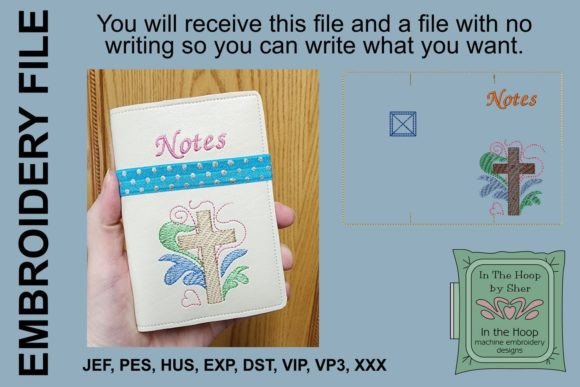
Cross Mini Composition Notebook Cover
A Quiet Statement That Draws the Faithful—and the Curious
As someone who’s stitched 300+ craft fair booths and helped over 50 Etsy sellers scale their embroidery lines, my first impression of Cross Mini Composition Notebook Cover is this: it’s reverent without being stiff, minimal without feeling sparse, and instantly legible at booth-distance. It doesn’t shout—it invites. That’s gold at a handmade market where shoppers pause for 2.7 seconds before moving on. This isn’t a bold, graphic cross for streetwear; it’s a soft, centered composition that reads as elegant and intentional, leaning into quiet faith rather than festive flair. Think farmhouse chapel, not cathedral banner—ideal for customers who value subtlety, craftsmanship, and spiritual resonance in everyday objects.
Where It Shines (and Where It Doesn’t)
Cross Mini Composition Notebook Cover performs strongest when treated as a finished functional item, not just an embroidery file. On a mini composition notebook cover—especially one made from linen-cotton blend or soft denim—it becomes a tactile, giftable piece: compact, meaningful, and instantly recognizable as handmade. That’s your anchor product.
It also works beautifully as a small-scale accent on complementary items: top-left corner of a tea towel, center-back of a child-sized apron, or centered on a fabric pouch. But avoid forcing it onto curved or high-stretch surfaces like baseball caps—the design’s clean lines rely on stable, flat fabric to retain clarity. On textured towels? Yes—but only with medium-weight cutaway stabilizer and reduced stitch density in tight areas. On dark fabric? Confirm thread contrast early; light ecru or ivory thread may vanish unless paired with a white underlay.
As a tote bag design? Too small as a standalone. Use it as part of a trio—cross + “Bless This Mess” + tiny olive branch—grouped in one corner for cohesion. As a standalone embroidered patch? Absolutely—just verify the smallest cross detail holds up at 2.5” width. For pillow covers or market bags? Scale up only if the original file supports it cleanly; otherwise, it loses its delicate balance.
Production Realities: Speed, Clarity, and Consistency
This is a step-by-step in-the-hoop machine embroidery design, which means production time per unit is predictable—and that’s critical when you’re stitching 40+ units the night before a craft fair. The instructions appear straightforward, but here’s what I check every time: hoop size compatibility (is it truly 4x4 or does it push 4.25”?); stitch density in the cross arms (dense fills can pucker lightweight fabrics); and whether lettering is large enough to remain legible on 3.5” notebooks after washing. Tiny religious text often blurs—so if “not” in “religious not” refers to a word like “notebook” or “notes,” confirm spacing and font weight before batch running.
Photographing Cross Mini Composition Notebook Cover for Etsy or Instagram is easy: natural light, neutral background, notebook held at slight angle to show cover texture and stitch sheen. It translates well into printable mockups—no complex shadows needed. And yes, it’s highly repeatable: once you dial in tension, stabilizer, and thread colors, you can run 20 identical covers in under two hours.
Booth & Brand Impact: Why It Belongs on Your Table
In a sea of bright totes and playful patches, Cross Mini Composition Notebook Cover adds tonal depth and emotional resonance. It appeals directly to church groups, Catholic school parents, Bible study leaders, and mindfulness-focused creatives—segments that buy repeatedly and refer others. When placed beside embroidered tea towels (“Bless This Kitchen”) and linen pouches (“Pray Often”), it strengthens your brand’s cohesive, values-driven story. No loud slogans needed. Just quiet consistency.
Visually, it balances out bolder pieces. A stack of three covered notebooks—cream, sage, and deep navy—becomes an instant display focal point. Add a handwritten chalkboard sign: “For Reflection. For Lists. For Grace.” Done. You’ve turned utility into meaning—and meaning into margin.
Careful-Use Notes Every Embroiderer Must Check
- Dense stitch areas: Cross arms and any outlined text may require reduced fill density on lightweight cotton or linen to prevent stiffness.
- Tiny details: If the design includes fine crossbar lines or small script, test at actual size on scrap fabric—what looks crisp on screen may blur when stitched.
- Small lettering: Verify readability on final product—especially if used on 3.5” notebooks. Letters under 6 pt rarely hold up.
- Thick fabric: Felt or heavy twill may swallow fine details. Opt for simpler fill patterns or increase underlay stitches.
- Textured towels: Terry cloth hides low-density stitching. Use tear-away + cutaway combo and slightly higher stitch count in key outlines.
- Curved cap surfaces: Not recommended—distortion risks misalignment and uneven tension.
- Dark fabric: Always run a test with your chosen thread. Light threads need white underlay on black or charcoal.
- Scaling down: Avoid shrinking below 3” wide—the cross proportions and spacing may collapse visually.
Designer-to-Designer Checklist Before You Stitch
- Test the machine embroidery design on scrap fabric matching your final product’s weight and weave.
- Check thread contrast—not just on white, but on your top 3 fabric colors.
- Review spacing between elements: Is there breathing room around the cross? Does text sit comfortably?
- Confirm hoop size matches your machine’s standard setup—or adjust files ahead of time.
- Inspect stitch density: Are fills smooth, or do they risk puckering on soft fabrics?
- Use the right stabilizer: Cutaway for stretchy knits, tear-away for stable wovens, hybrid for towels.
- Create at least one real mockup—not digital. Hold it. Flip it. See how light catches the stitches.
- Compare fabric colors side-by-side: Cream vs. oat vs. ivory changes perceived warmth dramatically.
- Confirm commercial licensing applies to finished product sales—this is non-negotiable for Etsy sellers and small shop owners.
Remember: Cross Mini Composition Notebook Cover isn’t just another embroidery file. It’s a quiet invitation—to pause, reflect, and carry meaning in something small, useful, and beautifully made. In a craft fair world full of noise, that kind of intention sells itself.