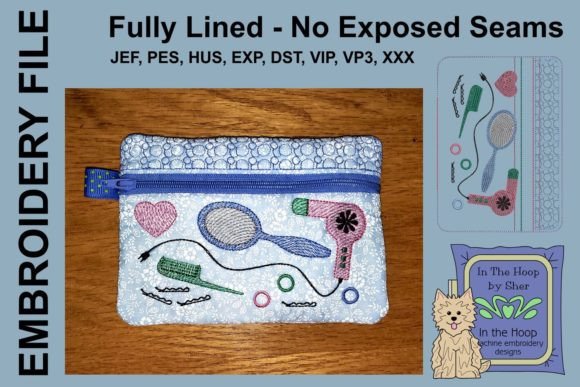
Hair Stylist Zipper Bag
A Professional Embroidery Designer’s Real-World Review
As an embroidery designer who’s helped over 200 small businesses launch cohesive, production-ready branded merchandise—from boutique salons to indie craft studios—I approached Hair Stylist Zipper Bag with a dual lens: aesthetic appeal and commercial practicality. The title alone signals clear intent: this isn’t just decorative—it’s occupational identity, stitched with purpose. Based on the description—“Stylishly showcase your passion for hairstyling with this chic embroidery design. Scissors, combs, and trendy elements add flair to your projects, making it a cut above the rest”—I immediately assessed its visual personality: modern, friendly, and confidently professional. It avoids cliché (no exaggerated hairdryers or cartoon curls) and leans into refined symbolism—scissors as precision, combs as care, “trendy elements” suggesting current design sensibility without sacrificing legibility.
Where Hair Stylist Zipper Bag Shines in Small Business Merch
This machine embroidery design excels where clarity, brand warmth, and industry relevance intersect. For a local hair studio launching staff uniforms, Hair Stylist Zipper Bag works beautifully as a chest logo on structured cotton-poplin shirts—clean lines hold up under moderate stitch density, and the balanced composition avoids visual clutter near pockets or seams. As an embroidered patch, it scales well onto denim aprons for barbershops or creative studios; the scissors-and-comb motif reads instantly at 2.5"–3", reinforcing craft expertise without needing text. On tote bags for client gifts or event merch, it anchors the lower corner with quiet authority—elegant enough for a luxury salon, approachable enough for a neighborhood co-op.
For Etsy sellers and handmade brands, Hair Stylist Zipper Bag functions as more than decoration—it’s a trust signal. When stitched onto reusable zipper pouches sold alongside hair oils or styling tools, it visually confirms artisanal alignment: the design says, “We understand your trade, your tools, your standards.” In cap embroidery, it holds strong on structured front panels (think unstructured cotton twill caps), especially when paired with subtle tonal thread colors that let the shape—not just the contrast—communicate professionalism.
Strategic Placement & Smart Limitations
Like any strong digital embroidery file, Hair Stylist Zipper Bag demands thoughtful placement. Avoid using it below 1.75" as a standalone patch—fine details in “trendy elements” may blur or lose definition on curved surfaces like baseball cap crowns or tightly seamed garment pockets. On dark uniforms (navy, charcoal, black), verify thread color contrast: light neutrals (ecru, soft grey) can recede; crisp white or heathered ivory often delivers better recognition. High stitch density areas—especially around intricate comb teeth or layered scissors—require appropriate stabilizer to prevent puckering on lightweight or textured fabric like linen-blend aprons.
Also consider end-use durability. If applied to items destined for frequent washing (staff aprons, salon towels), confirm the design avoids overly dense fill areas that could stiffen or crack over time. And while it’s ideal for custom apparel and boutique merchandise, avoid shrinking it into tiny product packaging accents—this isn’t a micro-logo design. Save those applications for simplified derivatives or monogrammed initials instead.
Brand Identity Impact: Beyond Aesthetics
Hair Stylist Zipper Bag strengthens brand identity by doing three things consistently: signaling expertise, inviting connection, and supporting visual consistency. When repeated across staff caps, tote bags, and product pouches, it creates a recognizable rhythm—customers begin associating the clean silhouette of scissors and comb with quality service and intentional design. That builds trust faster than generic floral or script logos because it speaks directly to shared language: tools, care, craft. For small business owners, that translates to higher perceived value—clients pay more readily for services wrapped in confident, industry-specific presentation.
It also supports handmade presentation without looking amateurish. Unlike overly ornate or whimsical motifs, Hair Stylist Zipper Bag balances charm with restraint—making it equally at home on a high-end bridal stylist’s silk scarf and a student stylist’s practice kit. That flexibility is rare—and invaluable—for businesses scaling from pop-up to permanent retail.
Practical Embroidery Designer Notes for Production
Before committing to bulk runs, here’s what I always do—and recommend you do—with Hair Stylist Zipper Bag:
- Test it in black and white first—this reveals spacing issues, unintended gaps, and outline integrity far better than color previews.
- Check how it performs at your smallest intended patch size (e.g., 2" x 2") on actual fabric—not just software. Does the comb remain distinct? Do scissors retain sharpness?
- Review thread color contrast on your target fabric swatches. Light-on-light can look elegant—but only if the texture and sheen support readability.
- Inspect spacing between elements: tight loops or overlapping shapes may require digitizing tweaks for smoother satin-stitch transitions.
- Confirm hoop size compatibility with your primary machines—some “trendy elements” may extend beyond standard 4x4 boundaries.
- Always test on real fabric with your chosen stabilizer. A design that looks perfect on polyester may distort on organic cotton canvas.
- Create a printable mockup for client approval—show it scaled on cap fronts, apron corners, and tote bag flaps. Visual context prevents misalignment surprises.
- Compare it beside your other design assets: does it harmonize with your wordmark, icon system, or secondary patterns—or clash in weight or energy?
- Verify commercial licensing before use in small business merch, commercial embroidery, or resale products. Never assume personal-use terms cover business distribution.
Remember: Hair Stylist Zipper Bag isn’t just a Work category embroidery file—it’s a brand amplifier. Used intentionally, it elevates apron embroidery into signature style, transforms cap embroidery into conversation starters, and turns every tote bag design into a walking portfolio. Whether you’re an embroidery shop prepping orders for a new salon launch or an Etsy seller building a cohesive handmade product line, this design earns its place—not as filler, but as foundation.