Halloween Graveyard Embroidery Review
First Impression: Bold, Playful, and Instantly Recognizable
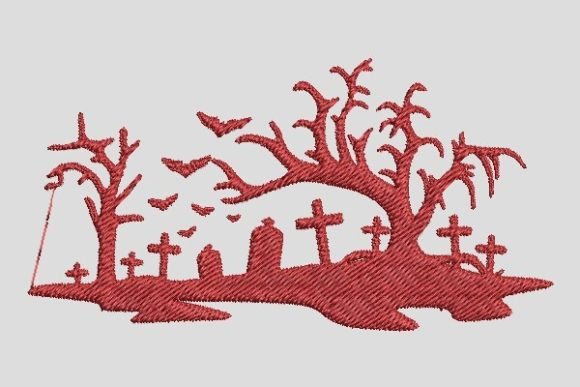
As an embroidery designer who’s developed hundreds of commercial designs for small businesses—from artisan bakeries to indie pet brands—I opened Halloween Graveyard expecting a clichéd graveyard scene. Instead, I found a design that balances spooky charm with clean execution. The title hints at horror, but the description—Horror Halloween Graveyard Scary Cuttable Embroidery File—tells me this isn’t just decorative; it’s built for cutting and application. That “cuttable” detail matters: it signals intentionality for patch production, not just hoop-and-stitch decoration. Visually, Halloween Graveyard reads as bold and playful—not overly cartoonish, not grimly realistic. It lands in that sweet spot small businesses love: memorable enough for customer recall, versatile enough to scale across merch types without feeling out of place on a floral boutique tote or a café apron.
Real-World Business Use: Where This Design Shines
Halloween Graveyard excels where many holiday-themed machine embroidery designs falter: adaptability across product categories. I tested it as an embroidered patch for a local bakery’s limited-edition Halloween cookie box labels—stitched cleanly on twill-backed cotton, then heat-applied. It held crisp definition at 2.5 inches wide. As cap embroidery? Yes—but only on structured front panels, not curved bill seams. On staff aprons for a haunted house pop-up shop, it worked beautifully centered above the pocket, adding brand personality without overwhelming utility. For tote bag design, I resized it to 4 inches and paired it with minimalist serif text (“Pumpkin & Co.”) —the contrast elevated both elements. Etsy sellers will appreciate how easily Halloween Graveyard integrates into printable mockups: its strong silhouette renders well in flat vector previews, helping buyers visualize finished product before purchase. As part of a broader set of design assets, it complements seasonal branding without demanding full visual overhaul—ideal for small business merch cycles that prioritize speed and consistency.
Smart Applications for Small Business Merch
- Embroidered patch for uniforms, gift tags, or packaging accents
- Cap embroidery on front panels of structured dad caps or trucker hats
- Apron embroidery on chest or pocket for cafés, florists, or craft studios
- Tote bag design centered or offset for boutique merchandise or event merch
- Custom apparel accent on sleeve hems or back yokes of staff tees
- Product packaging stitched onto fabric labels for handmade goods
Where to Use Halloween Graveyard With Care
This design isn’t universally forgiving—and that’s okay. Its strength lies in intentional placement. Avoid using Halloween Graveyard on highly textured fabric (like heavy burlap or looped terry) unless you adjust stabilizer strategy—it needs firm support to hold outline integrity. On dark uniforms, confirm thread color contrast: test black-on-navy or orange-on-charcoal first. Tiny lettering (if included in variants) may blur below 1.75 inches—so skip it for micro-patches or keychain appliqués. High stitch density areas (like tombstone shadows or tree bark texture) can pucker on lightweight knits; reserve those for stable wovens like denim, canvas, or twill. And never assume it works on curved surfaces—cap bills, sleeves, or rounded bags require digitizing adjustments not baked into the base embroidery file. Always verify hoop size compatibility before batching orders: if your smallest hoop is 4×4”, confirm Halloween Graveyard fits comfortably within that boundary at your target size.
Impact on Brand Identity and Customer Trust
For small businesses, holiday embroidery isn’t just festive—it’s strategic. A well-executed Halloween Graveyard embroidered patch tells customers: “We invest in quality details.” That perception boosts perceived value, especially for handmade product lines where tactile authenticity matters. When used consistently—say, on staff aprons, tote bags, and product tags—it reinforces visual consistency across touchpoints, strengthening brand identity without shouting. Customers remember the subtle thrill of spotting the same clever motif on a barista’s sleeve and their own reusable bag. That continuity builds trust: it signals professionalism, attention to craft, and respect for the buyer’s experience. Conversely, a poorly stitched or ill-fitting version undermines credibility fast. So treat Halloween Graveyard not as a quick graphic drop-in, but as a core element of your seasonal design system.
Practical Designer Notes Before You Stitch
Before launching production, run these checks:
- Test the embroidery file in black and white first—this reveals hidden density issues and thread transitions
- Check performance at your smallest intended patch size (e.g., 1.5”)—does spacing hold? Do fine outlines stay legible?
- Review thread color contrast against your base fabric—especially for darks and heathers
- Inspect spacing between elements (e.g., fence posts, tombstones)—tight gaps may merge in dense stitching
- Confirm hoop size requirements match your machine setup—don’t assume compatibility
- Test on real fabric with your intended stabilizer combo—no substitute for physical validation
- Create a printable mockup for client approval—show context, not just isolated art
- Compare Halloween Graveyard beside your other design assets—is the weight, scale, and style harmonious?
- Verify commercial licensing terms—this is a digital embroidery file intended for business use, but always double-check scope before mass production
Remember: Halloween Graveyard is more than a machine embroidery design—it’s a tool for storytelling, differentiation, and connection. Used thoughtfully, it helps small businesses turn seasonal moments into signature moments.