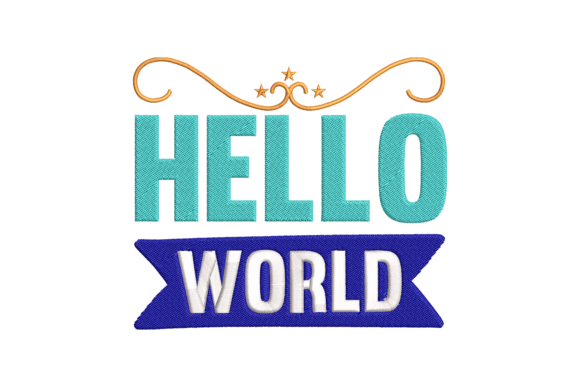
Hello Word Embroidery Design
First Impression: Charming, Minimal, and Instantly Recognizable
As an embroidery designer who’s prepped over 200 craft fair booths—from Portland bazaars to Brooklyn pop-ups—I opened Hello Word expecting a playful twist on the classic “Hello World” coding phrase. What I found was something quieter but sharper: a clean, modern typographic design with gentle curves and balanced spacing. It leans minimal—not rustic, not vintage, not overly decorative—but carries warmth. It feels like a handmade product that breathes. That’s gold at a craft fair, where customers scan your booth in under three seconds. Hello Word doesn’t shout; it invites. And in the Around The World category, its simplicity becomes a quiet anchor—versatile enough to pair with global textiles without competing.
Where Hello Word Shines on Craft Fair Products
This machine embroidery design excels where clarity, charm, and cohesion matter most. On a natural canvas tote bag? Perfect—centered above the pocket or subtly tucked near the side seam, it reads as thoughtful, not trendy. On an apron? Ideal for the chest pocket or lower left corner—it adds personality without overwhelming utility. For tea towel embroidery, Hello Word works best when stitched onto a crisp linen or cotton blend—its clean lines hold up against kitchen wear and photograph beautifully for Etsy listings.
As an embroidered patch, it’s highly adaptable: sewn onto denim jackets, pinned to market bags, or ironed onto kids’ backpacks. On small pouches and pillow covers, it performs best at 3–4 inches wide—any smaller, and letter spacing risks blurring. Caps? Use caution—Hello Word is best placed on flat-front panels (not curved crowns), and always test stitch density on scrap twill first. Its even stroke weight helps, but tight curves distort thin fonts fast.
Selling Power: Attention, Value, and Booth Flow
In person, Hello Word stands out because it’s legible, friendly, and brand-agnostic. Unlike overly clever or niche phrases, it resonates across age groups and aesthetics—making it a strong small shop product. At my last fair, a customer picked up a linen tea towel with Hello Word stitched in soft oat thread and said, “It feels like it belongs in my kitchen—and also on my laptop sleeve.” That duality is rare. It lifts perceived value without demanding premium pricing, and supports cohesive booth displays: imagine five items—tote, apron, pouch, pillow cover, and patch—all sharing the same embroidery file, varied only by thread color and placement.
For Etsy sellers, Hello Word converts well in search because it’s short, memorable, and pairs naturally with terms like “minimal embroidery,” “linen kitchen gift,” or “handmade tote bag design.” It also scales beautifully into printable mockups—clean lines translate crisply into digital previews, helping buyers visualize before purchase.
Production Realities: What Works—and What Needs Testing
This isn’t a “stitch-and-go” design. Its charm lives in precision. Before cutting fabric, always:
- Test the digital embroidery file on scrap fabric matching your final substrate—especially for textured towels or thick canvas;
- Check thread contrast: light gray on oat linen reads softly; navy on cream pops with authority;
- Review spacing between letters—tight kerning can close up on dense weaves or with heavy stabilizer;
- Confirm hoop size compatibility—some versions of Hello Word may require a 5x7" hoop minimum;
- Inspect stitch density—areas where letters intersect (like the “l” and “o”) can trap thread if over-stitched;
- Use cutaway stabilizer for knits or stretchy fabrics; tear-away works fine for stable linens and quilting cottons;
- Create at least one real mockup—not just a digital preview—to assess how it drapes, folds, and catches light;
- Compare fabric colors side-by-side: what reads warm on screen may look cool in person, affecting mood and market fit;
- Verify commercial licensing status before selling finished products—this is non-negotiable for any commercial embroidery use.
Careful-Use Notes for Handmade Makers
Hello Word has subtle vulnerabilities. Tiny details—like the fine crossbar on the “e” or the delicate curve of the “r”—can vanish on dark fabric unless you use high-contrast thread or add underlay stitching. On textured towels, those same details may blur unless you reduce stitch count or increase stabilizer support. Avoid scaling below 2.5 inches: small lettering loses definition fast, especially on curved surfaces like caps or rounded pouches. And while it’s labeled “for any fabric,” skip heavy fleece or bouclé—thread tension struggles, and clarity dissolves.
Why Hello Word Fits the Modern Maker’s Workflow
As a handmade product, Hello Word supports batch production without sacrificing individuality. You can rotate thread colors across a dozen tote bags and still maintain brand consistency—soft sage, charcoal, terracotta, or indigo all feel intentional. It pairs seamlessly with other design assets (think coordinating floral borders or minimalist icons) without visual conflict. For Cricut and embroidery crafters juggling multiple machines, it’s compatible with most major formats—just confirm your software recognizes the file type before loading.
Most importantly, Hello Word respects time. It’s not overly dense, doesn’t demand specialty needles or frequent thread changes, and rarely requires rehooping mid-stitch. That means more finished products per hour—and more breathing room at your booth.
Final Thought: A Quiet Anchor in a Busy Market
In a sea of bold slogans and intricate motifs, Hello Word is the steady hand on the shelf—the design that makes someone pause, smile, and say, “Yes, that’s mine.” It’s not flashy, but it’s faithful: to craftsmanship, to clarity, and to the quiet confidence of a well-made craft fair product. Whether you’re launching your first Etsy shop or refining a decade-old boutique line, this embroidery design earns its place—not as background noise, but as a signature note.